tabular ML · feature engineering · imbalanced classification
Credit Default Prediction
An end-to-end credit-risk classification workflow that turns repayment behaviour into robust features, tunes the operating threshold and finished first on the course leaderboard.
Problem
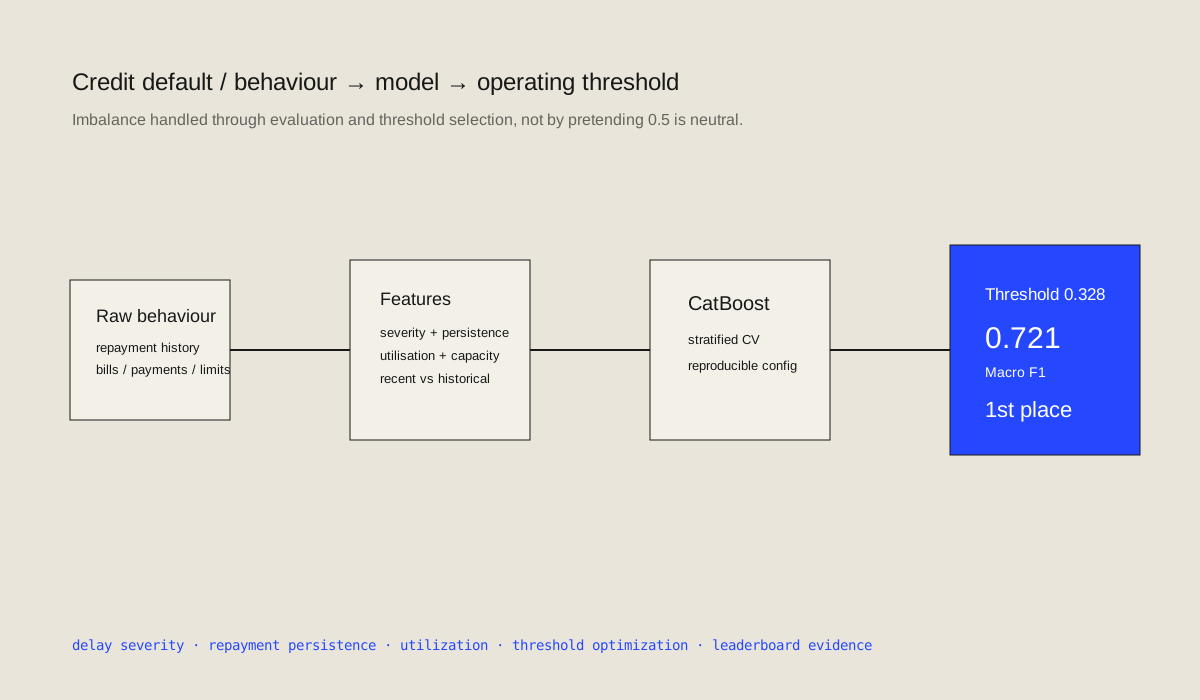
Credit default is an imbalanced classification problem where raw account fields hide the behaviour that matters. The challenge was to build a reproducible pipeline that captures repayment dynamics and optimizes for Macro F1 rather than defaulting to a 0.5 probability threshold.
What I built
The pipeline validates and cleans the input data, engineers delay severity and persistence, utilization, repayment-capacity and recent-vs-historical behaviour features, runs stratified cross-validation across CatBoost experiments, and chooses the final operating threshold against the target metric.
Public Macro F1 0.721 with a CatBoost configuration and decision threshold 0.328.
Engineering decisions
Where the project becomes more than a demo.
The details that matter are usually in the constraints: who is allowed to decide, what gets measured, what is kept separate, and how failure is represented.
Engineer behaviour, not just columns.
Raw repayment history, bills, payments and limits are converted into persistence, trend, exposure, capacity and coverage signals.
Treat threshold as part of the model.
The final classifier is evaluated with an operating threshold of 0.328 because the target metric and class imbalance make 0.5 arbitrary.
Keep experiments reproducible.
Feature flags and model parameters are controlled through configuration so leaderboard improvements can be traced to an actual experiment.
Evidence
What the repository actually supports.
selected final submission
CatBoost final configuration
optimized for the target metric
Limits
What I am not claiming.
- Leaderboard performance is an academic evaluation result, not a claim of production credit-risk performance.
- The final score depends on the course dataset and evaluation split.
- The project prioritizes reproducibility and operating-point selection over model novelty.
Signal